FIFA’s Investment Proposal Faces Strong Opposition from UEFA and Political Leaders
FIFA’s proposal to bring private investors into its commercial operations, including the FIFA World Cup, has triggered widespread debate, with UEFA and Greater Manchester Mayor Andy Burnham among the strongest critics of the idea.
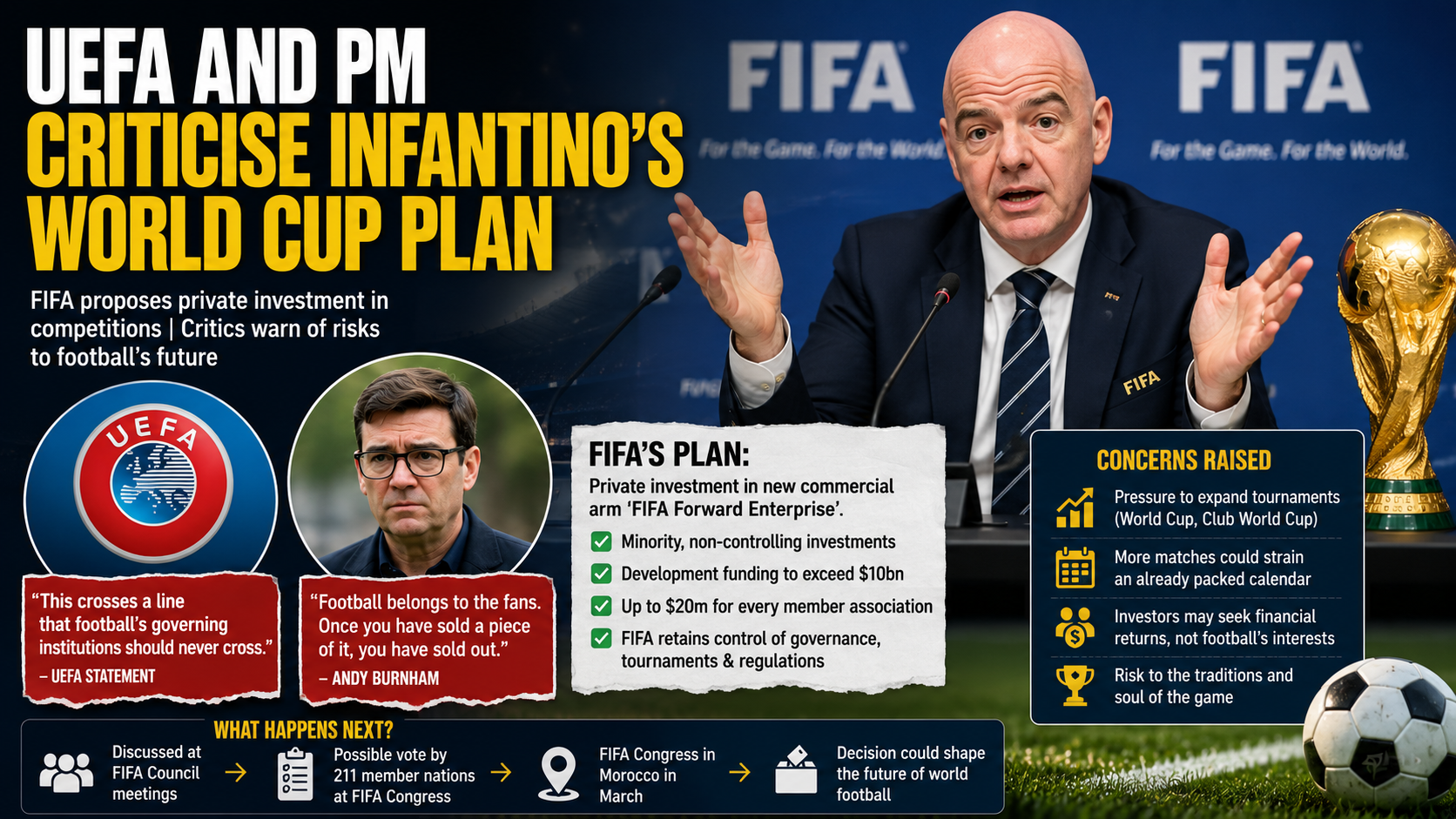
The world’s football governing body has unveiled plans to increase global football development funding to more than $10 billion (£7.5 billion) by creating a new commercial venture that would welcome outside investors while keeping FIFA in overall control.
For the latest football news, governance updates and international developments, readers can also follow coverage at Football Score Today.
FIFA Plans New Commercial Entity
According to FIFA, the proposal involves launching FIFA Forward Enterprise (FFE), a subsidiary designed to manage the organisation’s commercial rights and major events.
The governing body intends to invite minority, non-controlling investments from selected third-party investors. Before the proposal can move forward, it must receive approval from FIFA’s 211 member associations.
FIFA has stated that Thrive Eternal is expected to head the investment group if the proposal is accepted. The consortium is linked to Thrive Capital, an American venture capital company founded by Joshua Kushner.
Although media reports suggested FIFA President Gianni Infantino could personally benefit financially from the project, FIFA sources have denied there have been any discussions about him—or anyone else—serving as chief executive of FFE.
FIFA added that Infantino and senior officials have a responsibility to oversee the development of the project, although no further details have been provided regarding his exact role.
Greater Funding for Member Associations
One of FIFA’s key arguments is that the new structure would generate additional income to support football worldwide.
Under the proposal, every member association could receive up to $20 million (£15 million) in one-off funding to improve football infrastructure and development programmes.
Infantino said football’s growing commercial success should benefit every nation, not only the sport’s wealthiest markets.
He explained that FIFA’s responsibility is to promote sustainable and inclusive growth across every corner of the football world while ensuring the game’s financial success supports future development.
UEFA Says Proposal ‘Crosses a Line’
UEFA responded with a strongly worded statement, warning that football’s governing institutions should never allow ownership of the sport’s commercial future to be influenced by private investors.
The European governing body expressed concerns that financial shareholders could push for larger and more frequent FIFA tournaments in order to maximise returns, potentially affecting existing international competitions and placing even greater pressure on the football calendar.
UEFA argued that football’s governance, traditions and integrity should not become assets for commercial investment, particularly without complete transparency regarding who stands to benefit financially.
The organisation also stressed that football belongs to everyone involved in the game rather than any single governing body.
Andy Burnham Defends Football’s Traditions
Andy Burnham also criticised the proposal, insisting football belongs to supporters rather than investors.
He argued that the FIFA World Cup is one of the greatest sporting competitions in the world and should never become a commercial asset to be sold for financial gain.
Burnham maintained that football’s identity has always been shaped by fans, local communities and generations of supporters, not investment groups.
Meanwhile, the Football Association confirmed it had not been informed about FIFA’s plans before the announcement became public.
Experts Warn of Long-Term Consequences
Football finance expert Kieran Maguire believes the proposal could significantly increase FIFA’s revenues but warned that outside investors would naturally expect financial returns.
He suggested this could eventually create pressure to expand the FIFA World Cup to 64 teams, increase the frequency of major tournaments or further enlarge competitions such as the Club World Cup.
Such developments could place even greater strain on an already crowded football calendar and affect domestic leagues across Europe.
Decision Expected in the Coming Months
The proposal is expected to feature prominently during upcoming FIFA Council discussions before potentially being presented to all member associations for a vote at the FIFA Congress in Morocco next March.
If approved, the plan would represent one of the most significant commercial changes in FIFA’s history.
A Debate That Could Shape Football’s Future
Many figures within football believe the proposal represents the biggest governance debate since the failed European Super League project.
Supporters argue the additional funding would transform football development in emerging nations where investment is desperately needed.
Critics, however, fear commercial interests could eventually influence decisions surrounding tournament expansion, scheduling and the overall direction of the global game.
With national associations, leagues, clubs and players all expected to have their say, the coming months could prove crucial in determining whether FIFA’s vision becomes reality or faces significant resistance.